
Community College Coalition Contract Voting Documents and Timeline

WFSE members have voted to ratify the tentative agreement for your 2027-29 union contract!
Thank you to the bargaining team for their hard work at the negotiating table and every member who supported them by making calls, sending emails, and getting loud in our communities.
What's next? Get involved in our union's Legislative and Political Action program to win funding for your union contract, protect jobs and services, defeat the repeal of the Millionaires' Tax in November, pass the AI bargaining bill, and more.
For a bigger picture of how our contracts receive funding, check out our Road to a Fair Contract.
Don't fall for "Opt Out Today." Many of us are getting messages from a group called Opt Out Today, a project of the anti-worker, billionaire-funded “Freedom” Foundation.
In short, the people who have been trying to cut public workers pay and benefits for years aren't trying to save you money. Here's what they're really about.
Find details of the agreement below.
Negotiation of the 2027-2029 CCC Tentative Agreement (TA) has concluded.
As you all know, the budget deficit continues to grow, and compensation discussions were incredibly difficult as a result. While there is no additional compensation in the first year, we successfully fought off takeaways and have secured a reopener that will allow us to come back to the table and fight for compensation increases in the second year of the agreement.
Based on member feedback, your bargaining team leveraged that budget deficit to make every non-economic gain possible in these challenging budget times, and those gains are significant.
Because of these achievements, your CCC Bargaining Team recommends that you vote YES to ACCEPT this Agreement. A complete copy of the tentative agreement is available.
See the links below for a complete copy of the TA, highlights, voting instructions, a flyer, and an informational webinar on 9/22.
We want to thank you all for your hard work, research, job actions, and solidarity. Your strength makes all the difference!
If you have questions, contact the Member Connection Center (MCC) at [email protected] or 833-MCC-WFSE (1-833-622-9373).
Your WFSE CCC Bargaining Team

J Mott | Centralia CC |
Ward Kaplan | CCS |
Kimi Hanson | EVCC |
Scott Beals | GRCC |
Danielle Casey | LCC |
Tracy Stanley | LCC |
Tom Cline | PCC |
Johnny Dwyer | SCD District Office |
Emily Rodriguez | SCD North |
Bo McClung | SCD South |
Paul Fernandez | SHCC |
Dan Andreason | WCC |
Patti Hermoso | TCC |
Bear Ryver | SPSCC |
How Does Our Vote Impact Our Future?
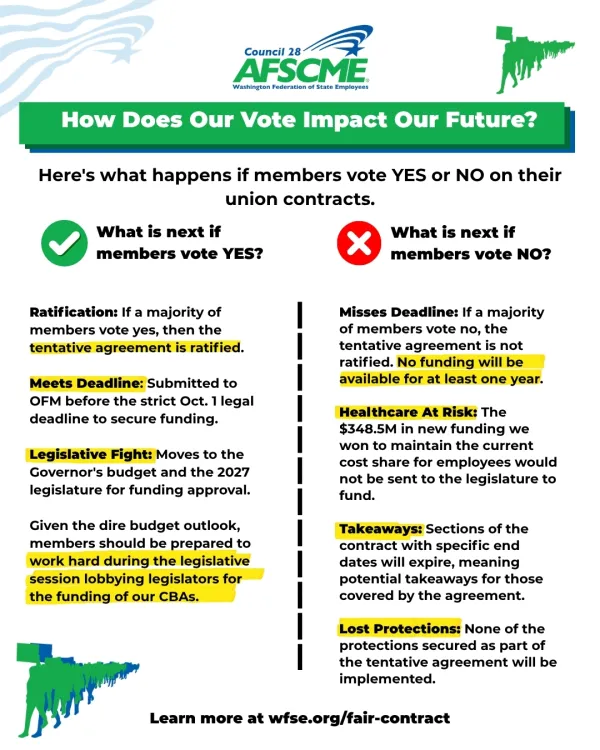
Here are the repercussions of a YES or NO vote
All of the collective bargaining agreements (CBA) currently being voted on are subject to RCW 41.80, which includes important requirements about the process and timeline of our negotiations. The information posted here details what would happen in accordance with state law, depending on the vote.
- What is next if members vote YES?
If a majority of members vote yes, then the tentative agreement is ratified.
This must be completed in September and communicated to the Office of Financial Management (OFM) prior to October 1, 2026, to meet the legally required deadline for any funding. For example, $348.5M in new funding is required just to maintain our current healthcare cost share.
Once that is complete, OFM determines “financial feasibility,” which is also a legally required step. From there, our tentative agreement makes its way to the Governor for inclusion in their proposed budget.
During the 2027 legislative session, our state’s legislators will determine whether our contracts are funded as a part of finalizing the state’s overall budget for the 2027-2029 biennium. Given the dire budget outlook, members should be prepared to work hard during the legislative session lobbying legislators for the funding of our CBAs.
You can learn more about how to get involved in that process here.
- What is next if members vote NO?
If members vote no, the tentative agreement is not ratified and there are several important ramifications to be aware of. First, the October 1 deadline is not flexible.
It is set in law and a no vote would mean we do not meet that deadline. Failing to meet the deadline means there is no funding for at least the first year of what would be the 2027-2029 CBA period. As noted above, an example of what requires new funding is the $348.5M in new funding required just to maintain our current healthcare cost share.
In addition to there being no funding, only the parts of our current contract that are in effect as of June 30, 2027, and do not have a specified expiration date, would carry forward for up to one year. That means that there would be numerous takeaways starting July 1, 2027.
In addition, none of the protections that have been secured as part of the 2027-2029 TA will be implemented.
Questions?
Need more information? Contact the Member Connection Center (MCC) at [email protected] or 833-MCC-WFSE (1-833-622-9373)
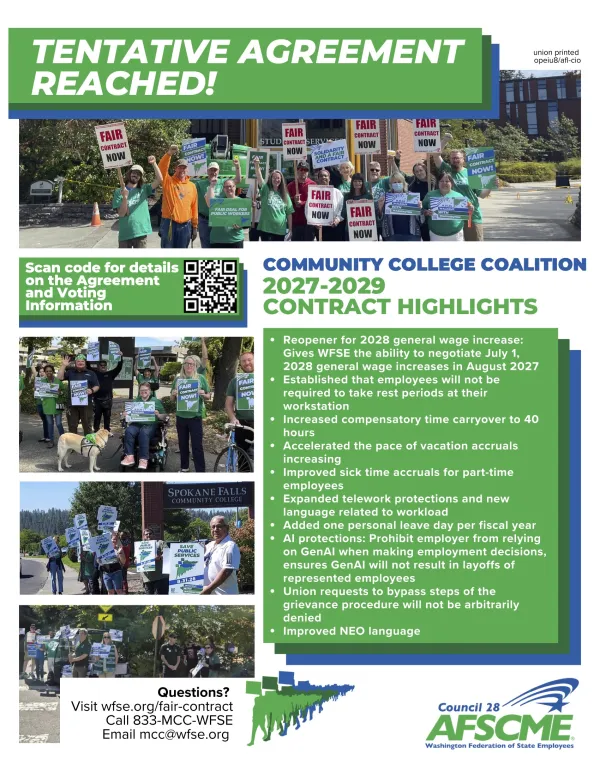
Download and Share the TA Highlights flyer
Highlights
As you all know, the budget deficit continues to grow, and compensation discussions were incredibly difficult as a result. While there is no additional compensation in the first year, we successfully fought off takeaways and have secured a reopener that will allow us to come back to the table and fight for compensation increases in the second year of the agreement.
Article 43-Compensation
- Reopener for 2028 general wage increase
NON-COMPENSATION HIGHLIGHTS
Article 3 – Workplace Behavior
- Strengthened the language regarding what is appropriate conduct.
Article 7 – Hours of Work
- Expanded home phone calls to include all forms of electronic communication;
- Established that employees will not be required to take rest periods at their workstation.
Article 8 – Overtime
- Increased compensatory time carryover to 40 hours.
Article 9 – Training and Employee Development
- CBA training will be offered to management at least annually;
- CBA steward training will accommodate a workday regardless of shift duration;
- When the employee and employer identify, through the evaluation process, professional development that will support the employee’s job performance or enhance service to students, that professional development may be made available to the employee at no cost. The employer will communicate in writing if such opportunity for professional development cannot be approved and reason why.
Article 11 – Vacation
- Accelerated the pace of accruals increasing;
- 5-15 years of service accrue 20 more minutes of leave each month.
Article 12 – Sick Leave
- Improved accruals for part-time employees.
Article 15 – Family and Medical Leave
- Added bereavement to PFML use;
- Made resources related to article 15 protected leaves more accessible.
Article 17– Suspended Operations
- Clarified that suspended operation pay applies to those required to work not just those required to report to campus during the suspended operation event;
- Made suspended operation policies/procedures more accessible;
- Added a language related to preparation for and notification of suspended operations.
Article 18 – Miscellaneous Paid Leave
- Personal Leave Day—See MOU;
- Changed wildfire disaster leave to disaster leave to apply leave to all forms of natural disaster.
Article 19 – Leave without Pay
- Personal leave added to leave that can be used in lieu of LWOP.
Article 21 – Uniform Tools and Equipment
- Added Stage Technician and Media Maintenance Technician series to list classifications that the Safety Footwear allowance applies to.
Article 24 – Telework Commute Trip Reduction and Parking
- Improved language regarding telework eligibility, requests, changes, and grievability.
Article 27 – Resignation and Abandonment
- Union will be copied on notices of separation;
- Enabled the Union to petition for reinstatement on employee’s behalf.
Article 29 – Discipline
- Every thirty (30) days after the notification that discipline is being contemplated, or an investigation has concluded the Employer will send an update on the status of the discipline being contemplated.
Article 30 – Grievance
- See Bypass MOU.
Article 35 – Layoff and Recall
- Mandates resources when layoffs occur;
- In the event of temporary layoffs districts will investigate and consider ESD’s shared work program;
- Notice of permanent layoff increased from 21-30 days.
Article 38 – Union Management Communication Committee
- Allows for Union to request release for two alternates, but only 6 will attend meetings.
Article 39 – Seniority
- Employees will be notified when list updated.
Article 40 – Union Rights and Activities
- Moved representation to employee rights article;
- Expanded use of state email by Union;
- New language related to Union Requests for Information;
- NEO: within 45 days of a new employee’s start date districts will provide employee’s name, job title, college campus and shift details (day or night) to the Union by email to [email protected], the staff representative and the Chief Steward;
- NEO: lengthened access to new employees from 30-60 minutes;
- NEO: lengthened time Union can speak with employees from 30-60 minutes during in-person NEOs;
- Miscellaneous leave for Secretary and treasurer.
Article 42 – Classification
- When reallocation occurs because the State HR Director creates, abolishes, or revises a class, and an employee’s duties have not changed:
- Employees allocated to the same or lower salary range will maintain the same salary (y-rate).
- Employees reallocated to a class with a higher salary range will be placed at the same step in the new range (step to step).
- Position review requests: If an allocation determination is not made within the sixty (60) calendar days the employee will be provided with a status report, and every thirty days (30) thereafter until a determination is made;
- Union will be copied on Employer notifications of position review determinations;
- Effect of reallocations: if the new class’s range is less than 15% higher the step placement will be 5% higher or the entry step of the new range, whichever is higher;
- Effect of reallocations: if the new class’s range is more than 15% higher the step placement will be 10% higher or the entry step of the new range, whichever is higher.
NEW Article – Employee Rights
- Moved Union representation language from article 40 to here;
- Moved Volunteers and student workers language to here;
- Moved Privacy and Off Duty Conduct language to here;
- Moved Legal Defense language to here;
- New Workload language which is grievable to step 3;
- New Duty Station Language;
- New Exit Interview language.
MOU – Generative Artificial Intelligence (GenAI)
- Prohibits employer from relying on GenAI when making employment decisions;
- GenAI will not result in layoffs of represented employees.
MOU —Wage Reopener
- Gives WFSE the ability to negotiate July 1, 2028 general wage increaes in August of 2027.
MOU – Article 30 Bypass
- Union requests to bypass steps of the grievance procedure will not be arbitrarily denied.
MOU – Personal Leave Day
- Provides an additional 1 workday as a personal leave day each fiscal year of the agreement.
Your CCC Bargaining Team recommends you
VOTE YES TO ACCEPT this Agreement!
How did we get here?
Read all the Community College Coalition bargaining updates from this round of negotiations on our CCC landing page here.