What’s the Priority?
Learn what to do when your workload goes beyond what you can do in 40 hours. This article applies to both workers and supervisors, although specifics relating to overtime do not apply if you’re in an OT-exempt position. If you are in probationary or in-training status, you should talk to your steward or council rep before following these steps. Updated based on the 2025 - 2027 collective bargaining agreement (CBA).
I feel like my workload isn’t manageable in the time I have. [Article 36.7]
You definitely aren't alone. As often as our management loves to tell us to just do more with the time we (don't) have, we are only superhuman - there is a limit to how much we can do in a day.
Article 36.7 of the CBA covers workload, although it is not currently grievable – meaning it isn't as enforceable as it could be. It does give us and our management a process to follow other than simply trying harder, working off the clock, cutting corners, or going off of vibes. We do still suggest talking with a steward or council rep if you are unsure how your supervisor will respond, you don't have permanent status, you're concerned about possible retaliation, or you have any questions at all.
The moment you realize that you have too much to do, the first thing you need to do is to get yourself into a place where you can make a plan. You may want to use one of your 15-minute breaks, or your one-hour unpaid lunch, to take a moment to breathe. Very few of us have jobs where we can do everything on our to-do list in the time we're allotted, and if we don't recognize that, we will burn out - doing a disservice to our coworkers and the families we serve, as well as to ourselves and our own families. You aren't going to get it all done. But you'll get a lot more done if you're rested, calm, and aware of your limits.
Sure. Fine. I'm totally relaxed or whatever. What now?
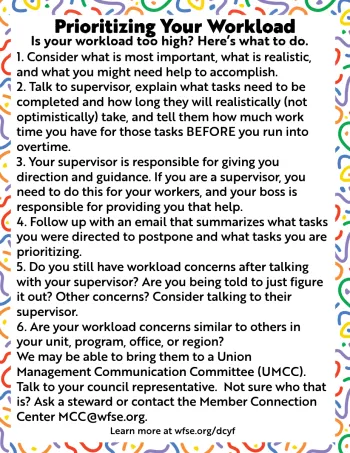
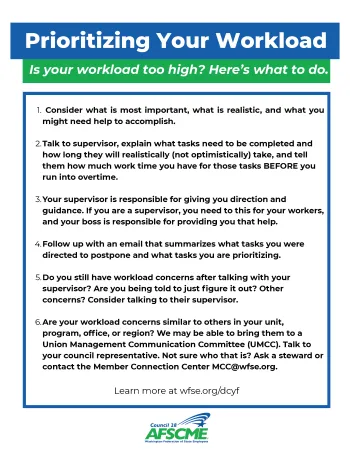
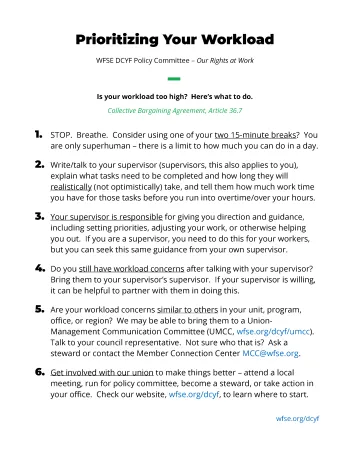
Once you're feeling up for it, talk to your supervisor. It's best to do this in writing if possible. Tell them what tasks need to be completed and how long they will realistically (this is not the place for optimism) take to accomplish. Tell your supervisor how much work time you have for those tasks before you run into overtime/over your hours. You don't have to list every little thing, but be accurate about it. If you're very behind on court reports or safety assessments, your supervisor should be aware.
Your supervisor – not you – is responsible for giving you direction and guidance, including setting priorities, adjusting your work, or otherwise helping you out. If you come to them with a dozen overdue tasks, a petition to write, and five court hearings scheduled for that morning, they should tell you where to start and what order to do the tasks in. They should help redistribute work, find coverage, or otherwise help you carry the load. If they don't do this, ask them directly, e.g., "Do you want me to write the court report for X or attend the hearing for Y? If you want me to do both, I will need 3 hours of overtime." If it seems like they're telling you to work off the clock, get that in writing and talk to a steward or council rep. We can't work without pay, so it's their job to decide what gets done and what doesn't.
If you are a supervisor, you do need to provide this guidance for your workers, but you can seek the same guidance from your own supervisor. Do you need to schedule too many supervisions for the hours left in the month? Are too many of your own workers asking for guidance, and you can't make it all fit and still meet court deadlines? Email your supervisor to ask what to do.
My supervisor couldn't/didn't provide guidance, or they're in the same spot as I am. What's next?
The next step is to bring these issues to the attention of your supervisor's supervisor. If your supervisor is willing, it can be helpful to partner with them in this. If they aren't, or if either of you have questions, please contact a steward or council rep before doing this.
If that didn't solve the issue, you would then contact your council rep, steward, or other union leadership to share what's going on. Workload may then be raised as an issue at a Union Management Communication Committee. This is where we focus management's attention on the issues that impact us, and where we often attempt to create informal agreements with management to address those issues. This might mean that management sends out an update with guidance on prioritizing workload. It might also mean that we develop escalating actions through our union to address workload issues if they don't implement changes.
You could also file a complaint if your supervisor or their supervisor didn't discuss your workload concerns with you; we suggest contacting a steward or council rep if you're considering this.
As always, consider talking with others in your office or local union, or joining our Policy Committee's Facebook group if you'd like to find out about any similar experiences others have had.
I'm worried about confrontation, or about how not working off the clock will impact families.
It is true that there is an element of directness to this process. But addressing this issue is one thing that truly is our responsibility, as public servants and - for many of us - as Social Workers. Working off the clock contributes to burnout, it makes our coworkers look bad for sticking to their boundaries, and it makes our management and legislature think we don't have a workload problem - worsening the issue over time. Sugarcoating the workload problem and burying it in burnt-out workers won't make it go away.
The key to all of this is transparency and a willingness to believe that things can change. We all need to be open and honest about the hours we work and what we can accomplish (or what we can’t). We need to support and encourage each other to do this as well. This is the only way we are ever going to achieve a manageable workload. You are not inadequate or uncaring for having healthy boundaries, for being unable to carry dozens of families on your shoulders without help, or for the ongoing failures of our system, our legislators, and our leadership. Following the guidance here is the first step towards creating change.
Find a variety of flyers below: